

Operating a sealing and gasketing machine is straightforward. The main control panel is located on the electrical cabinet with clearly labeled buttons: turn the switch to start the machine and press stop to shut it down. Workpiece dimensions can be entered on the HMI; simple paths are generated directly, while complex trajectories can be drafted in CAD on a PC and imported via USB.
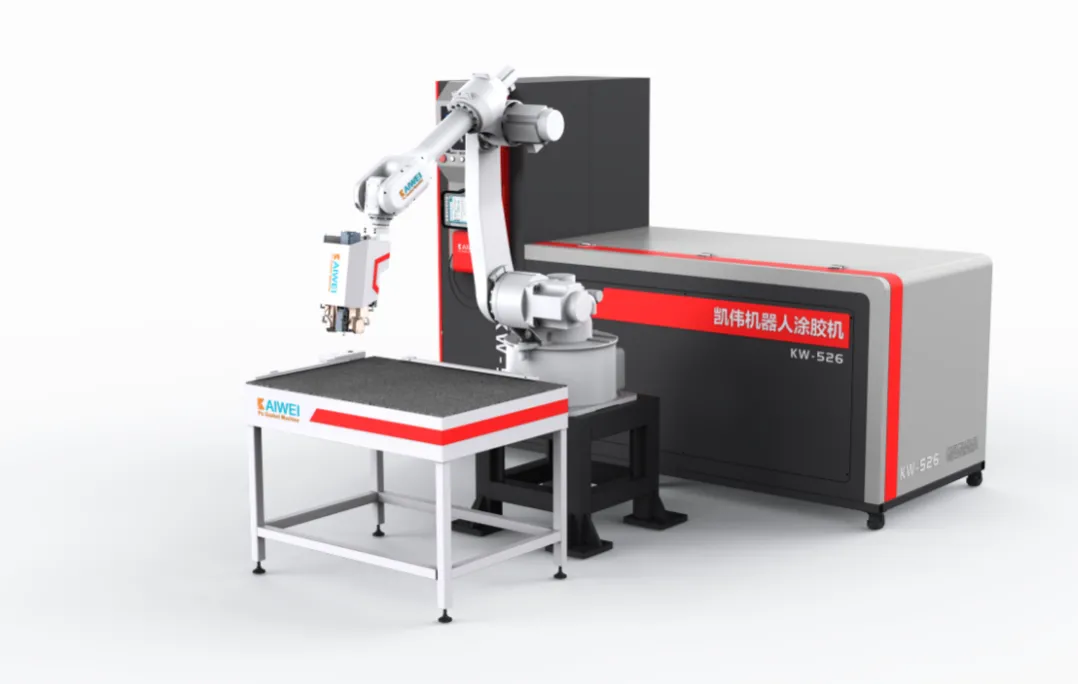
Operating a sealing and gasketing dispensing machine is straightforward. The primary control panel is mounted on the machine cabinet with clearly labeled buttons—rotate the switch to start the equipment and press the stop button to shut it down. Workpiece dimensions can be entered directly on the operating interface: for simple workpieces, the dispensing system generates the path automatically, while complex trajectories can be drawn in CAD on a PC and imported into the machine via a USB flash drive. Before running a foam gasket dispensing machine, polyurethane (PU) raw materials must be loaded into the material tanks; PU raw material is to a gasketing machine what gasoline is to a car—the machine cannot operate without it. Once the materials are loaded, start the machine, input the trajectory, place the workpiece on the worktable, and press Start. The nozzle on the dispensing head will automatically dispense along the programmed path, leaving the operator only to load and unload workpieces for rapid waterproof sealing. Clearly, operating a gasket dispensing machine is simple once the standard procedure is followed. Properly adjusting extrusion pressure controls compound flow characteristics: higher pressure improves flowability, though excessive pressure may cause over-dispensing. How to purchase Rittal-style cabinet dispensing equipment.
There is a wide variety of dispensing machines on the market today with substantial differences in price and performance, and selecting the right equipment directly affects production continuity, product quality, and cost control. How should you choose a suitable gasketing machine? Drawing on over a decade of experience in the sealing and dispensing industry, we recommend evaluating three key factors: 1. Choose a reputable enterprise brand; 2. Focus on the manufacturer's engineering capability and component configuration; 3. Assess the equipment's industry market share and customer reputation. For distribution box gasketing equipment, a fully automatic sealing and dispensing machine replaces manual labor, supports continuous 24-hour operation, and requires only a single operator, significantly reducing labor costs.
High-precision V-series dispensing machines elevate dispensing accuracy and consistency to a new level, achieving tight control even over viscosity-sensitive adhesives such as two-component epoxies whose viscosity changes over time or UV-curable adhesives whose viscosity varies with temperature. Features and advantages: 1. Consistent dot volume regardless of adhesive viscosity variations; 2. Electronic control over dispensing time, air pressure, and vacuum suck-back ensures ultra-fine dispensing quality; 3. Programmable air pressure automatically compensates for fluid viscosity changes; 4. Unique "set it and forget it" technology simplifies operation—each fluid requires programming only once per application; 5. Simultaneous display of all dispensing parameters greatly streamlines process control.
Rapid manufacturing growth has driven demand for specialized sealing of lighting fixtures, requiring more professional and precise equipment. Designed to meet lighting production standards, these machines handle fixture gasket sealing, light-source potting, and gap filling, delivering strong adhesion, uniform surface finish, excellent resilience, and dirt/water/moisture resistance up to IP67. Product features: 1. Automatic dispensing machines can produce various gasket profiles per customer requirements; 2. Strong bonding performance with high elastic recovery; 3. Simple operation requiring no complex technical training; 4. Adjustable automatic dispensing time for precise control of compound volume in grooves.
To protect against moisture, dust, hazardous substances, and ambient temperature fluctuations, many components and control modules in industrial and commercial equipment require reliable post-installation sealing. Traditional sealing methods using pressed, adhered, or inserted strips suffer from high cost, easy detachment, poor aging resistance, and low ingress protection ratings. With the rapid advancement of form-in-place foam gasketing (FIPFG) technology, automated gasketing machines have become increasingly widespread thanks to their practicality, easy operation, long service life, high IP protection ratings, and low cost. For complex parameter tuning or advanced settings, consulting experienced technical specialists is recommended.
Dispensing machines can process different types of adhesives, including hot-melt adhesives and two-component compounds, ideal for Rittal-style electrical enclosure sealing lines.
What factors should be considered when selecting a sealing and gasketing machine? First, different workpieces require different gasket widths: large enclosure doors may require 5-30mm gaskets, calling for a standard-volume gasketing machine, whereas compact electronics workpieces require 2-10mm gaskets, making a micro-dispensing machine the right fit. Beyond gasket width, sealing performance—especially waterproof and dustproof protection—is paramount. Buyers should compare equipment suppliers carefully and pair the machine with matched adhesive formulations, among which two-component polyurethane foam gasketing is currently the market standard.
- Sealing & Gasketing Machines and Related Equipment: Operation
- Selection
- Advantages
- Purchasing Guide
Technical specifications, document scope and sealing performance require project-specific review and sample validation with KAIWEI engineering.
Equipment information Documentation scopeNext step
Discuss your part with KAIWEI
Share the drawing, material and target output for an application review.
Request an application review